 EN
EN

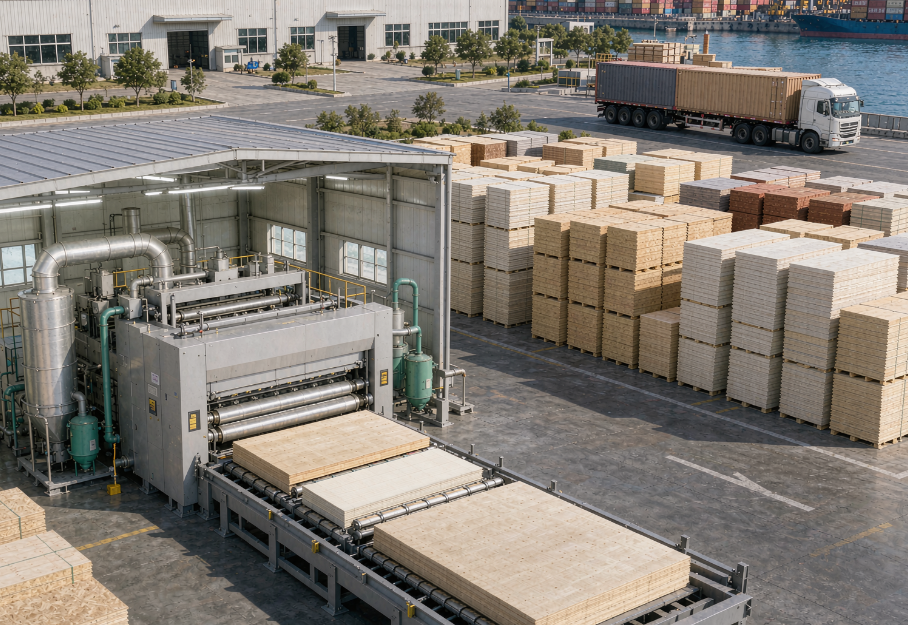
According to data from the China Wood-Based Panel Industry Report 2025, by the end of 2024, the national total production capacity of wood-based panels had climbed to 362 million cubic meters per year, a year-on-year increase of 8.41%. Driven by the dual forces of tightening environmental regulations and intensified market competition, the industry's restructuring process has notably accelerated, with the number of manufacturers shrinking to just over 8,600, down 14.9% year-on-year. The stark contrast between continuously expanding capacity and the shrinking number of enterprises clearly confirms that outdated production capacity is being phased out at a faster pace. Industry resources and market share are increasingly concentrating toward leading enterprises with technological, scale, and green production advantages, propelling the industry concentration into a fast lane of sustained growth.
In the first half of 2026, exports of the three main panel types—particleboard, plywood, and fiberboard—all showed significant growth. Against a backdrop of overheated investment in particleboard and mounting domestic inventory pressure, leading enterprises actively tapped into overseas markets by leveraging continuous press production lines, formaldehyde-free adhesive technologies, and various green product certifications, effectively absorbing the newly added capacity. As stringent environmental standards such as ENF and HENF grades gradually become the new market threshold, small and medium-sized enterprises are finding themselves increasingly disadvantaged in cost control and technological upgrading. The industry is rapidly transitioning from the previous extensive, fragmented, and disordered pattern toward a new stage of intensive development characterized by high standards and high concentration.